
Book Review: Historia y Genealogía de la Familia Casas en el Norte de México (1511–1940)
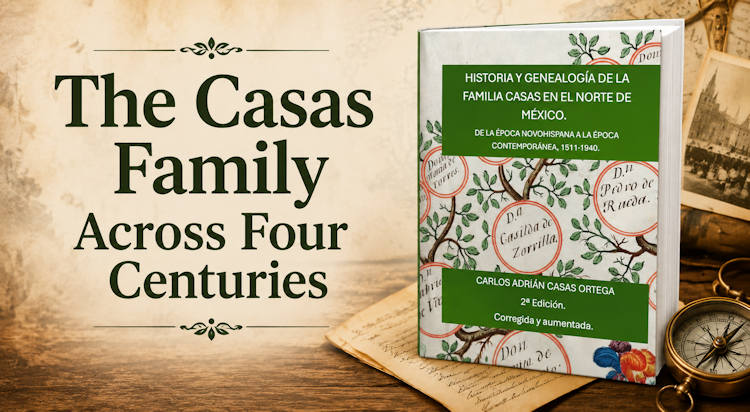
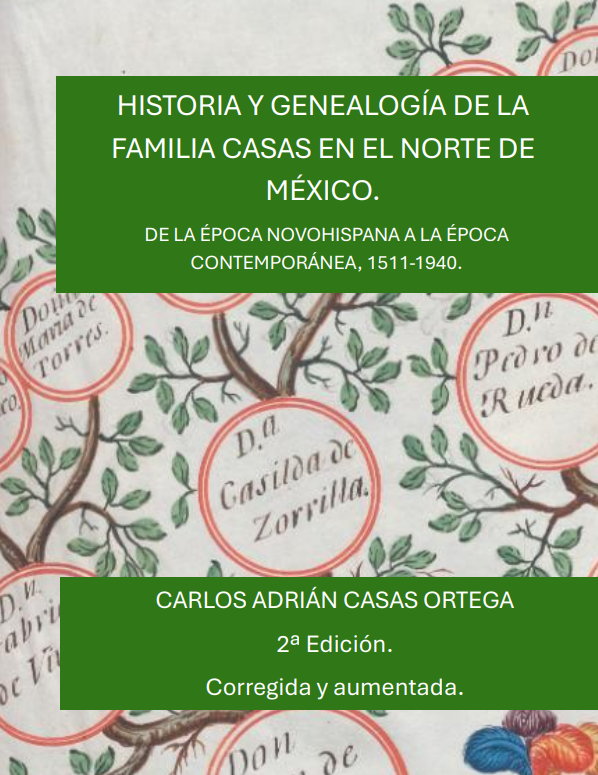
Few genealogical works published in recent years attempt what Carlos Adrián Casas Ortega accomplishes in Historia y Genealogía de la Familia Casas en el Norte de México. De la Época Novohispana a la Época Contemporánea, 1511–1940. This massive 514-page study traces the history, migration, social networks, and descendants of the Casas family from the early colonial period through the first half of the twentieth century.
What makes this book especially valuable is that it goes far beyond the traditional genealogical format of names, dates, and family trees. Instead, the author uses genealogy as a tool to explain the development of northern Mexico itself. From Saltillo and Monterrey to Cadereyta, Chihuahua, and beyond, the story of the Casas family becomes a lens through which readers can understand settlement patterns, mining enterprises, land ownership, migration, social mobility, and the formation of regional identities.
One of the strongest aspects of the work is its methodology. Casas Ortega relies on an impressive collection of archival sources, including records from the Archivo General de la Nación, Archivo General de Indias, municipal archives in Saltillo, Monterrey, Cadereyta, Monclova, Parral, and Mazapil, as well as parish records and FamilySearch collections. For genealogists, this extensive documentation provides confidence that the conclusions are grounded in original records rather than repeated family traditions.
The author begins by addressing a question that every family historian should consider: Why does genealogy matter? He argues that genealogy is not merely the study of ancestry but a discipline that helps explain how families shaped communities, economies, and regions over time. This perspective will resonate with many researchers who have discovered that tracing a family line often reveals much larger historical stories.
Another notable contribution is the author's willingness to challenge long-standing genealogical assumptions. Throughout the book he examines previous theories regarding the origins of Bernabé de las Casas and carefully compares them with documentary evidence from Mexico and the Canary Islands. In doing so, he demonstrates the importance of returning to original sources rather than accepting published genealogies at face value.
The scope of the work is remarkable. The table of contents alone reveals a detailed exploration of multiple Casas family branches, including the Casas Navarro, Lobo Guerrero de las Casas, Casas Carvajal, Casas de la Mota, Casas Vargas, Casas Peña, Casas Villalobos, Casas López, and Casas Andreu lines. Numerous genealogical charts, maps, land studies, and family reconstructions accompany the narrative.
For researchers with roots in Nuevo León, Coahuila, Chihuahua, Texas, or neighboring regions, the book offers valuable context even if they do not descend from the Casas family. The intermarriages documented throughout the work connect the Casas lineage to many prominent northern Mexican families, creating opportunities for researchers to identify collateral lines and broader kinship networks. The author's central argument—that family networks played a critical role in the regional development of northern Mexico—is convincingly demonstrated through generations of documented evidence.
If there is a challenge for readers, it is the sheer depth of the material. This is not a casual family history but a serious scholarly work that rewards careful reading. Researchers looking for quick ancestral summaries may find the level of detail overwhelming. However, genealogists and historians interested in methodology, source analysis, and regional history will find the book exceptionally rewarding.
Get Your Free Copy Here
Final Assessment
Historia y Genealogía de la Familia Casas en el Norte de México demonstrates what genealogy can achieve when combined with rigorous historical research. It is simultaneously a family history, a regional history, and a model for how genealogical scholarship can contribute to our understanding of the past. For anyone researching northern Mexico, colonial settlement patterns, or interconnected family networks in Nuevo León and Coahuila, this work deserves a place on the reference shelf.
Recommended for: Genealogists, local historians, descendants of northern Mexican families, and researchers interested in the social history of Nuevo León, Coahuila, Chihuahua, and Texas.