
A Guide for Mexican American Family History Research
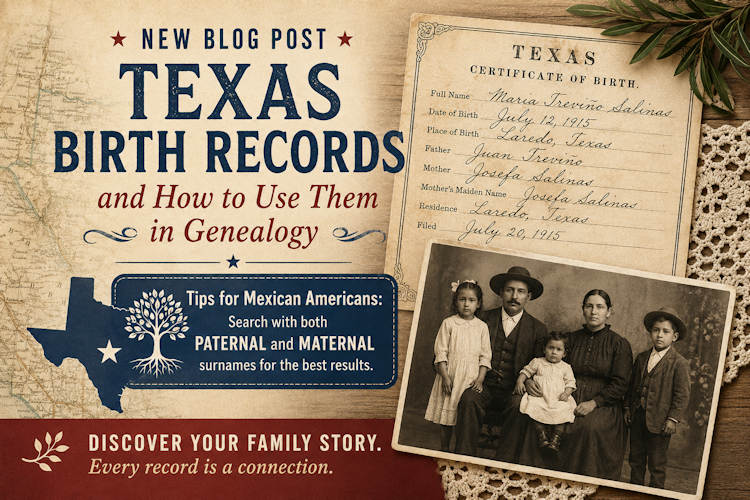
For family historians and genealogists researching families in Texas, birth records are some of the most valuable documents available. They can reveal parents’ names, family origins, occupations, addresses, and connections that help build accurate family trees across generations. For Mexican American researchers especially, Texas birth records often serve as the bridge between records created in the United States and records found in Mexico.
Whether you are researching recent generations or trying to identify an ancestor born in the early 1900s, understanding how Texas birth records work—and how Hispanic naming traditions affect searches—can make your research far more successful.
Why Texas Birth Records Matter
Texas birth records can help you:
- Identify both parents of an ancestor
- Discover maternal maiden names
- Confirm dates and places of birth
- Locate family residences
- Trace migration patterns between Mexico and Texas
- Connect siblings within a family group
- Distinguish between individuals with common surnames
Many researchers focus heavily on census records, but birth certificates often contain details that census records never recorded.
For Mexican American families, birth records are especially important because they may preserve the original Spanish naming structure that later records shortened or Americanized.
What Information Is Found on Texas Birth Certificates?
The amount of information depends on the year the record was created, but Texas birth certificates commonly include:
- Full name of child
- Date of birth
- Place of birth
- Father’s full name
- Mother’s full maiden name
- Parents’ birthplaces
- Parents’ occupations
- Address or residence
- Name of attending physician or midwife
Older delayed birth certificates may also contain affidavits from relatives, baptismal information, or supporting documentation.
When Did Texas Begin Recording Births?
Texas counties began recording births at different times, but statewide registration became more consistent after 1903.
Researchers should know:
- Some counties kept earlier birth registers before statewide registration
- Compliance improved significantly after the 1920s
- Many Mexican American births near the border were recorded late or not at all
- Delayed birth certificates became common for individuals needing proof of citizenship, Social Security benefits, or passports
Because of this, researchers should always search for:
- Standard birth certificates
- Delayed birth certificates
- Baptismal records
- County birth registers
- Border crossing records
Understanding Hispanic Naming Traditions
One of the biggest mistakes researchers make is searching for Mexican American ancestors using only one surname.
Traditionally, Hispanic individuals used:
- The father’s paternal surname
- Followed by the mother’s paternal surname
For example:
José García Martínez
- García = father’s paternal surname
- Martínez = mother’s paternal surname
In many American records, this person might later appear as:
- Jose Garcia
- Joe Garcia
- Jose G. Martinez
- Jose Martinez
- Jose Garcia-Martinez
Because of this, genealogists must search creatively.
Tips for Searching Texas Birth Records for Mexican American Families
1. Search Using Both Surnames
Always search with:
- Paternal surname only
- Maternal surname only
- Both surnames together
- Hyphenated versions
- Reversed order
A child recorded as:
Maria Treviño Salinas
might later appear as:
- Maria Treviño
- Maria Salinas
- Maria Trevino
- Maria S. Treviño
Small spelling variations can completely change search results.
2. Search Using Spanish and English Variations
Names were frequently translated or Americanized.
Examples include:
| Spanish Name | English Version |
|---|---|
| José | Joseph/Joe |
| Juan | John |
| Guadalupe | Lupe |
| Jesús | Jesse |
| María de Jesús | Mary |
Surnames also changed:
- Peña → Pena
- Treviño → Trevino
- Muñoz → Munoz
Always search with and without accent marks.
3. Search by Parents Instead of the Child
If the child cannot be located, search using the parents’ names.
This is extremely useful when:
- The child’s first name changed later
- The surname was shortened
- The record was indexed incorrectly
- Multiple children were born with similar names
Searching by the mother’s maiden name is often the key to finding hidden records.
4. Consider Delayed Birth Certificates
Many Mexican Americans born in rural Texas or near the border did not receive official birth certificates at birth.
Later in life, they may have filed delayed birth registrations using:
- Church baptismal records
- School records
- Census records
- Affidavits from relatives
These records can contain rich genealogical detail and may include information absent from the original record.
5. Use Baptismal Records Alongside Civil Birth Records
For Catholic Mexican American families, baptismal records are often just as important as civil birth certificates.
A baptismal record may include:
- Grandparents’ names
- Godparents
- Town of origin in Mexico
- Family relationships
- Legitimate/illegitimate birth status
In some communities, baptisms were recorded even when births were not.
Where to Find Texas Birth Records
Researchers can locate Texas birth records through:
Texas Department of State Health Services
Official statewide birth certificate records.
County Clerk Offices
Some counties maintain older local birth registers.
FamilySearch
Excellent for digitized Texas county records and indexes.
FamilySearch Texas Collections
Ancestry
Contains Texas Birth Index collections and related databases.
Local Catholic Diocesan Archives
Helpful for sacramental records and border communities.
Common Challenges in Texas Mexican American Genealogy
Researchers frequently encounter:
- Multiple individuals with identical names
- Inconsistent surname usage
- Late registrations
- Incorrect birth years
- Anglicized names
- Missing accent marks
- Border migration between Texas and Mexico
The key is persistence and flexible searching.
Never assume a record does not exist simply because the exact spelling does not appear in a database.
Final Thoughts
Texas birth records are foundational documents for building accurate family trees. For Mexican American genealogy, they are especially valuable because they often preserve naming traditions and family connections that later records may obscure.
Understanding paternal and maternal surnames can completely transform your research success. A record hidden under a maternal surname or alternate spelling may be the breakthrough that connects your Texas ancestors back to their hometown in Mexico.
The most successful family historians and genealogists learn to search broadly, think culturally, and understand how names evolved across generations and borders.