
Every genealogist knows that names, dates, and places are only part of the story. To truly understand our ancestors, we must also understand the communities where they lived, the events they experienced, and the historical forces that shaped their lives. One of the most valuable—and often overlooked—resources for researching South Texas and Northeastern Mexico history is the UTRGV Studies in Rio Grande Valley Regional History Series.
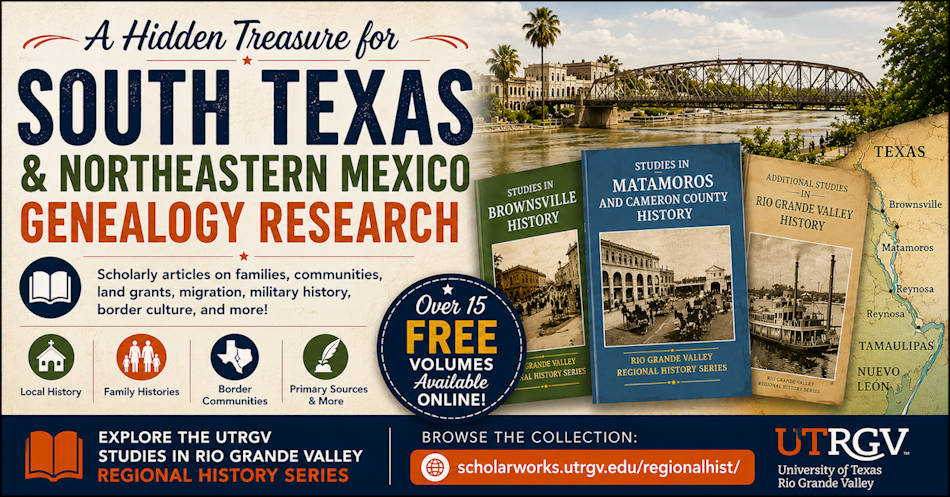
The collection, hosted by the University of Texas Rio Grande Valley (UTRGV), contains over 15 of free downloadable volumes covering the history of the Rio Grande Valley, South Texas, Tamaulipas, Nuevo León, Coahuila, and the broader borderlands region.
Access the collection here:
https://scholarworks.utrgv.edu/regionalhist/
The series features articles written by historians, anthropologists, archivists, and regional scholars from both the United States and Mexico. Topics include settlement history, migration, ranching, politics, military conflicts, education, folklore, border culture, and biographies of significant individuals and families. The collection reflects the unique bilingual and bicultural heritage of the Rio Grande Valley and Northern Mexico. Many articles are available in English, Spanish, or both.
Why Genealogists Should Use This Collection
Family historians researching South Texas and Northeastern Mexico will find valuable historical context that can help explain:
- Migration between Mexico and Texas
- Early settlements and land grants
- Ranching families and communities
- Border conflicts and military service
- Economic and social conditions
- Development of towns and municipalities
- Hispanic and Mexican-American political history
- Cultural traditions and folklore
Understanding these topics often provides clues that are not found in traditional genealogical records.
Recommended Volumes for Genealogical Research
Studies in Brownsville History
https://scholarworks.utrgv.edu/regionalhist/1/
This first volume contains articles on the Coahuiltecan legacy of South Texas, early settlers, Brownsville-Matamoros history, the Espíritu Santo Grant, nineteenth-century transportation, and even a family history of Texas Senator Hector Uribe. Researchers with roots in Cameron County, Brownsville, Matamoros, and surrounding areas will find this volume particularly useful.
Studies in Matamoros and Cameron County History
https://scholarworks.utrgv.edu/regionalhist/5/
This volume includes articles on Matamoros, Cameron County, local political history, prominent families, military figures, historic neighborhoods, journalism, architecture, and border culture. It is especially valuable for researchers whose ancestors lived on either side of the Rio Grande.
Additional Studies in Rio Grande Valley History
https://scholarworks.utrgv.edu/regionalhist/8/
Contains articles covering regional history, economic development, social conditions, and cultural topics relevant to understanding the historical environment in which our ancestors lived.
Yet More Studies in Rio Grande Valley History
https://scholarworks.utrgv.edu/regionalhist/13/
Researchers interested in both Texas and Mexican history will find articles discussing politics, government, economics, and social history throughout the borderlands region.
Don’t Overlook the UTRGV Special Collections
In addition to the Regional History Series, UTRGV maintains extensive digital collections that support research into South Texas and Northeastern Mexico history.
Special Collections & Archives:
https://scholarworks.utrgv.edu/speccoll/
These collections include photographs, maps, newspapers, personal papers, oral histories, government records, and other materials documenting the history and development of South Texas and Northeastern Mexico.
Historical Newspapers Guide:
https://utrgv.libguides.com/SCA/newspapers
Researchers can also explore historical newspapers and publications that may contain obituaries, community news, legal notices, and other valuable genealogical information.
Final Thoughts
As genealogists, we often spend countless hours searching for records that document our ancestors’ lives. However, understanding the world they lived in is equally important. The UTRGV Regional History Series is one of the finest free online resources available for researchers of South Texas and Northeastern Mexico.
Whether your family comes from Brownsville, Matamoros, Reynosa, Mier, Camargo, Monterrey, Cerralvo, Cadereyta, Saltillo, or countless other communities throughout the region, these publications can help you place your ancestors within their historical context and better understand the stories behind your family tree.
If you have not yet explored this remarkable collection, I encourage you to spend an afternoon browsing the volumes. You may discover historical details that transform a collection of names and dates into a rich and meaningful family history.