
In this post you can read about the books that have been published by the three local historians and authors. Books are essential to genealogy because they provide historical context, preserve information from records that may have been lost or destroyed, and often contain family histories, local histories, church records, land records, and other valuable resources not available online.
They help researchers understand how ancestors lived, identify family connections, trace migration patterns, and overcome research obstacles by offering clues and expert analysis. More than just names and dates, books help bring ancestors’ stories to life and provide a deeper understanding of the communities and historical events that shaped their lives.
With that, lets talk about the books that are available at the Archivo Historico Municipal Capitan Blas Maria de la Garza Falcon. For more context to this post please read my previud post here “Visiting the Camargo Archives“. There I mentioned that this week I would share a list of books that the archive staff have published.
Lets start with the works of Profesor Francisco Aguirre Garza.
Books by Francisco Aguirre Garza
- Camargo En La Pluma de Los Visitantes Nacionales y Extranjeros 1
- Camargo En La Pluma de Los Visitantes Nacionales y Extranjeros 2
- Camargo En La Pluma de Los Visitantes Nacionales y Extranjeros 3
- Camargo En La Pluma de Los Visitantes Nacionales y Extranjeros 4
- Camargo En La Pluma de Los Visitantes Nacionales y Extranjeros 5
The above series focuses on compiling, translating into spanish, and commentary about what visitors wrote about Camargo. These books are excellent to view Camargo through the eyes of many visitors and get an idea of how your ancestors lived and or might have experienced during those times. They also contain very valuable information about the indegenous people of the area and many millitary campaigns.
Another book of his is:
- Indios Carrizos Yue De Camargo Idioma Cotoname
This book is a linguistic work of the local indigenous Cotoname language words translated into spanish.
Now Lets Talk About the Books by Profesora Belia Espinoza Morin.
Books by Belia Espinoza Morin
- Indice the Protocolos de Instrumentos Publicos Libros 1, 2, 3, 4, 5, 6, 7
- Indice the Protocolos de Instrumentos Publicos Libros 8, 9, 10, 11, 12, 13
- Indice the Protocolos de Instrumentos Publicos Libros 14, 15, 16
- Indice the Protocolos de Instrumentos Publicos Libros 17, 18, 19
- Indice the Protocolos de Instrumentos Publicos Libros 20, 21, 22, 23, 24
This book series is invaluable since it contains extracts of every record found in these books that are currently in the archives. Making it easier for us to request a copy of documents. Olso, please note that these books do not have the compilers name but from what I unsdestood they were compiled by Profesora Beli and I think with the help of Professor Víctor M. Sáenz Ramírez. Below are more books.
- Patrimonio Historico del Bajo Rio Grande – A translation of Florence Johnson Scott’s Historical Heritage of the Lower Rio Grande.
- Solicitudes Matrimoniales De Los Archivos de Congregacion Ochao Tamaps. Delas Siguintes Comunidades: La Qumada, St. Rosalia, Ochoa, Primavera, La Pexcada, Etc. Años 1920, 1930, 1940
- Los Autos de la General Visita de la Villa de Camargo, Años de 1767
The above are great resources. The Solicitudes Matrimoniales are a treasure to anyone from that area. Los Autos book is great since it show the Camargo porciones were measured and given off to the settlers on both sides of the river. Now lets talk about the book by Professor Víctor M. Sáenz Ramírez.
Book by Víctor M. Sáenz Ramírez
The above book is available on Amazon and it is a great resource. It contains the full transcription of the protocolos for that time period. I have two copies, I bought one and another copy was given to me by my prima Marta Garcia.
How to Buy These Books
For those of you that are like me and like to buy books. With the exception fo the last one, all books lsited here can be bought at the Camargo Muncipal Archives. All funds go back to maintaining the building, digitization efforts, and buying equiptment for the archives. Also, note that all books are in Spanish and you have to go in person to buy them.
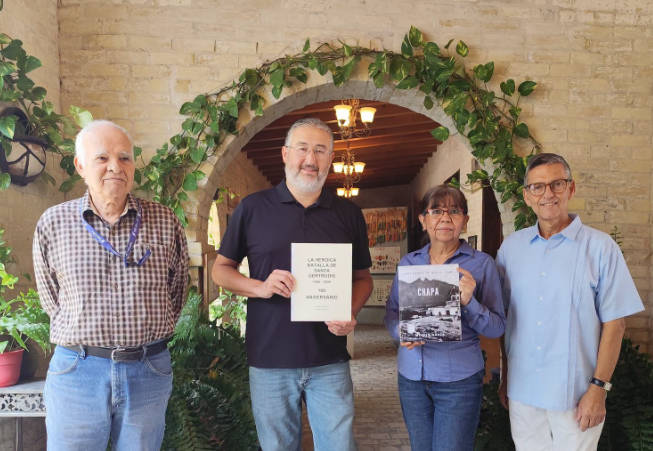
Note: The above photo left to right: Professor Victor M. Saenz Ramirez, Moises Garza, Professora Belia Espinoza Morin, and Maestro Francisco Jose Aguirre Garza.