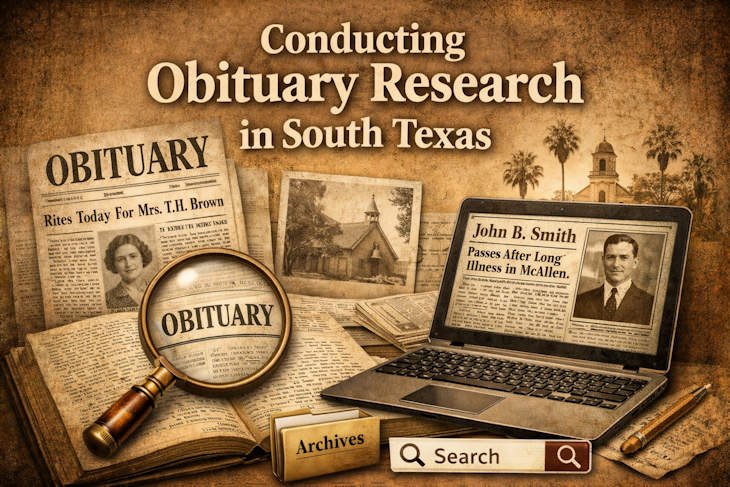

Obituary research is one of the most valuable—and often overlooked—tools for genealogists researching families from South Texas and northeastern Mexico. Because this region historically functioned as a shared cultural and familial space rather than a rigid border, obituaries frequently preserve cross-border family connections that are difficult to find in other record types.
For researchers tracing families from Nuevo León, Tamaulipas, and Coahuila, South Texas obituaries often serve as a critical link between Mexican parish records and United States civil documentation.
Why Obituaries Matter in South Texas Genealogy
South Texas obituaries tend to contain more genealogical detail than those found in many other regions. Depending on the time period and newspaper, an obituary may include:
- Full names of parents, sometimes including maiden names
- Place of birth in Mexico
- Names and locations of siblings on both sides of the border
- Migration history or length of residence in Texas
- Burial location and funeral home information
- Church affiliation or military service
Because many families migrated gradually—often crossing the Rio Grande multiple times—obituaries can preserve details not recorded elsewhere.
Regional Context: A Shared Borderlands History
Cities such as Laredo, Brownsville, McAllen, San Antonio, and Corpus Christi have long served as migration hubs for families from northeastern Mexico.
It was common for individuals born in Mexican towns such as Monterrey, Linares, Cerralvo, Mier, or Camargo to later appear in South Texas records. Obituaries published decades after migration often explicitly name these places of origin.
Language Considerations: Spanish and English Obituaries
Language plays a crucial role in South Texas obituary research. Many newspapers published obituaries in both English and Spanish, and Spanish-language newspapers operated independently throughout the region.
Researchers should note that:
- Spanish-language obituaries often preserve full compound surnames
- English-language obituaries may simplify or Anglicize names
- Dates and place names may vary depending on language and reporter
Whenever possible, both Spanish and English searches should be conducted for the same individual.
Where to Find South Texas Obituaries
Local Newspapers
Local newspapers are the primary source for obituaries. Coverage varies by location and time period, but many South Texas papers extend into the late 1800s.
Public Libraries and Archives
Libraries frequently maintain:
- Newspaper microfilm collections
- Local obituary indexes
- Vertical files organized by surname
Funeral Home Records
Some funeral homes kept registers or issued printed memorial cards that predate standardized obituary publication.
Online Collections
Digitized obituary databases, newspaper archives, and cemetery memorial sites can be useful starting points, but they should not replace onsite or regional research.
Using Obituaries as Research Leads
Obituaries are secondary sources and should be treated as research guides rather than final proof. Information is often supplied by relatives who may not know exact dates, especially for events that occurred in Mexico many years earlier.
Best practices include:
- Verifying obituary information with church and civil records
- Correlating details with census and land records
- Using stated places of origin as leads for parish research
When evaluated carefully, obituaries point researchers toward primary documentation.
Connecting Obituaries to Mexican Records
One of the greatest values of South Texas obituaries is their ability to reconnect families to Mexican records. A single obituary may identify:
- A specific town or parish in Mexico
- Parents’ full names
- Siblings who remained in Mexico
These clues can then be used to locate baptismal, marriage, and burial records in northeastern Mexico, extending documented lineages across generations and borders.
Final Thoughts
For genealogists researching South Texas and northeastern Mexico families, obituary research is not optional—it is essential. These records reflect a shared regional history shaped by migration, kinship, and continuity rather than political boundaries.
When combined with parish registers, civil records, and land documents, South Texas obituaries provide one of the strongest foundations for reconstructing accurate and well-documented family histories.
Related Posts:
Browse or Search The Brownsville Daily Herald. (Brownsville, Tex.) 1897-1910 Online