

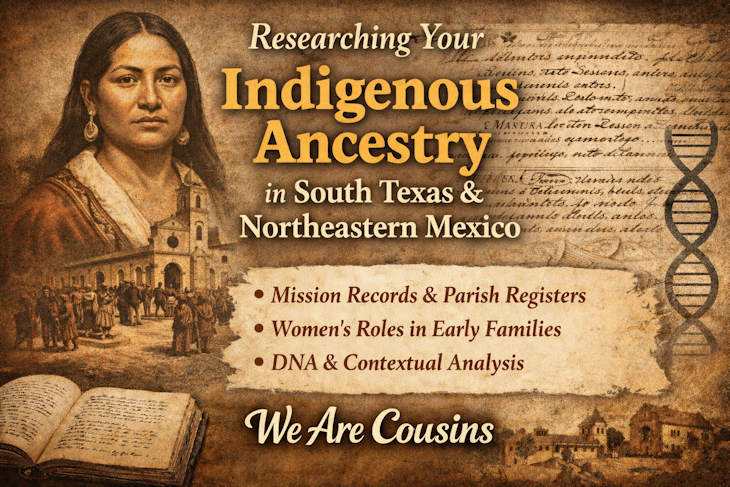

Understanding Native roots in the borderlands through records, context, and careful analysis
For many families from South Texas and Northeastern Mexico, Indigenous ancestry is present—but often hidden behind Spanish surnames, incomplete records, and centuries of cultural blending. Unlike other regions of Mexico where Indigenous communities remained distinct and documented, the borderlands followed a different path.
This article explains why Indigenous ancestry is harder to trace in this region, what records can still reveal, and how to research Native roots responsibly and accurately—without myths, assumptions, or overreach.
Why Indigenous Ancestry Looks Different in the Borderlands
South Texas and Northeastern Mexico were frontier regions. By the time permanent Spanish settlements were established, Indigenous populations had already been disrupted by:
- Disease
- Forced relocation
- Missionization
- Warfare
- Assimilation into Spanish households
As a result, many Indigenous people did not appear in records as members of distinct tribes. Instead, they were absorbed into colonial society and documented under broad or vague labels.
This is why Indigenous ancestry in this region often appears as:
- “India,” “Indio,” or “Natural”
- “Mulato,” “Mestizo,” or “Castizo”
- Or not labeled at all
Understanding this context is critical before you begin searching.
Common Indigenous Groups of the Region (Historically)
While dozens of small bands lived in the region, records often grouped them together rather than naming tribes individually. In South Texas and Northeastern Mexico, you may encounter references to:
- Local nomadic hunter-gatherer groups
- Mission Indians associated with Spanish missions
- Indigenous women integrated into Spanish households
Important note: Modern tribal names rarely appear in colonial records. Expect regional or generic terms instead.
Where Indigenous Ancestry Appears in Records
Indigenous ancestry in the borderlands is rarely stated outright. Instead, it must be inferred by analyzing multiple record types together.
1. Baptismal Records
Baptisms may include:
- Racial descriptors (e.g., “india,” “mestizo”)
- Notes about legitimacy or orphan status
- Godparents from Indigenous or mixed-background families
Pay close attention to:
- Repeated use of “india” for women
- Children baptized without named fathers
- Indigenous godparents within Spanish families
These clues are subtle—but powerful.
2. Marriage Records
Marriage records are especially valuable because they may note:
- Racial classifications
- Dispensations (often involving Indigenous ancestry)
- Places of origin or mission affiliation
Look for marriages where:
- One spouse is labeled “india” or “natural”
- The couple required a dispensation
- Witnesses include mission residents
3. Burial Records
Burial records may contain:
- Racial descriptors
- Social status clues
- Location of burial (mission vs. parish cemetery)
Indigenous individuals were sometimes buried in:
- Separate mission cemeteries
- Unconsecrated or marginal areas
- Or simply listed without surnames
A lack of surname can itself be an important clue.
Missions: A Critical but Misunderstood Source
Spanish missions played a major role in documenting Indigenous people—but they must be used carefully.
Mission records may include:
- Baptisms of Indigenous adults
- Children given Spanish surnames at baptism
- Entire families renamed and reassigned
However:
- Indigenous surnames were rarely preserved
- Families may appear under multiple surnames across generations
- Mission registers often end abruptly
When using mission records, focus on patterns, not single entries.
Indigenous Women and Spanish Surnames
One of the most common paths of Indigenous ancestry in South Texas and Northeastern Mexico is through women.
Indigenous women often:
- Married Spanish or mestizo men
- Took their husband’s surname
- Passed Indigenous ancestry to future generations invisibly
This means many families with long-standing Spanish surnames still carry Indigenous ancestry—even if no record states it explicitly.
To identify these lines:
- Track women across baptisms, marriages, and burials
- Watch for racial labels disappearing over time
- Study godparent networks involving Indigenous families
Why You Won’t Find “Tribal Rolls” for This Region
A common frustration is the absence of:
- Tribal enrollment lists
- Federal recognition records
- Clear tribal continuity
This is normal for the borderlands.
Most Indigenous groups of South Texas and Northeastern Mexico:
- Were not federally recognized
- Did not survive as isolated political entities
- Were absorbed into colonial society
Genealogy here is about ancestry, not modern tribal affiliation.
Using DNA to Support Indigenous Ancestry
DNA testing can be a useful supporting tool, but it cannot replace records.
Autosomal DNA may show:
- Indigenous American ancestry percentages
- Shared segments with regional cousins
However:
- DNA cannot identify a specific tribe
- Percentages vary by company and algorithm
- Endogamy can inflate or distort results
Use DNA to confirm, not to speculate.
Common Myths to Avoid
When researching Indigenous ancestry in this region, avoid these mistakes:
- Assuming all families are Indigenous because they lived in Texas
- Claiming tribal affiliation without documentation
- Treating DNA percentages as proof of specific tribes
- Ignoring Spanish and Catholic cultural integration
Responsible genealogy respects both history and evidence.
A Practical Research Strategy That Works
If you suspect Indigenous ancestry in your South Texas or Northeastern Mexico line:
- Start with parish records, not family stories.
- Track women carefully across generations.
- Note racial descriptors and when they disappear.
- Analyze godparents and witnesses for Indigenous connections.
- Use mission records to supplement—not replace—parish data.
- Add DNA only after building a paper trail.
This method prioritizes evidence over assumption.
Why Indigenous Ancestry Matters—Even When Records Are Quiet
Indigenous ancestry in the borderlands often survives without names, tribes, or labels—but it is still real. It shaped:
- Family survival on the frontier
- Cultural practices
- Foodways, labor, and daily life
- The genetic legacy of modern South Texas families
Acknowledging this ancestry requires humility, patience, and careful research—but it adds depth and truth to your family’s story.
Final Thoughts
Researching Indigenous ancestry in South Texas and Northeastern Mexico is not about finding a single document that “proves” everything. It is about assembling context from fragmented records, understanding colonial systems, and recognizing how Indigenous people were absorbed into a changing world.
When done correctly, this research doesn’t just answer questions—it restores voices that history often tried to erase.
Related Book
Indians of the Rio Grande Delta – If you have come across an ancestor that was a Native American from this region, this is the book to read. You will get a complete picture of how their lives were and of the struggles that they may have suffered. It is also great to learn about the tribes that lived in this area.
Great information. When seeing natural following hijo or hija doesn’t this mean out of wedlock, or unmarried parents? When would we see natural as a potential race descriptor? Could you give an example?
It will ussually say “los Naturales” or “indios naturales”