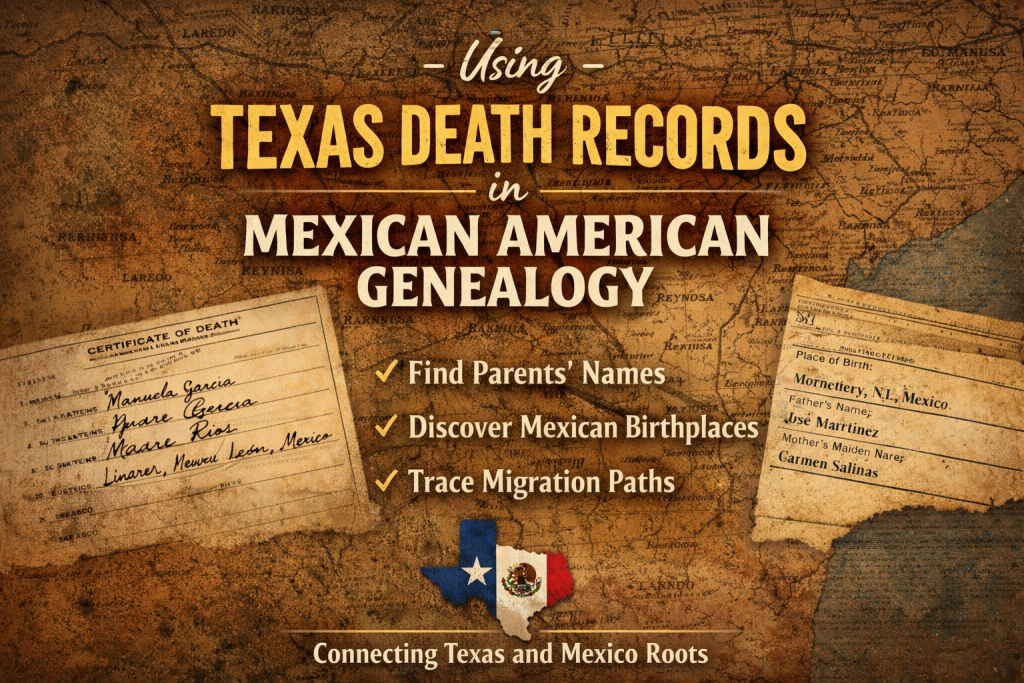

For those of us researching Mexican American families—especially in South Texas—Texas death records are one of the most powerful and underused genealogical sources available.
Whether your ancestors lived in the Rio Grande Valley, Laredo, San Antonio, or migrated north for work, a Texas death certificate can unlock multiple generations in a single document.
As genealogists working with families from Nuevo León, Tamaulipas, and Coahuila who later settled in Texas, we often find that death records bridge the gap between U.S. and Mexican records.
When Did Texas Begin Keeping Death Records?
Statewide registration of deaths in Texas began in 1903. While some counties kept earlier records, consistent statewide certificates start in the early 20th century.
This is especially important for Mexican American research because:
- Many families crossed the border during the late 1800s and early 1900s.
- Civil registration in Mexico began in 1859, but access can sometimes be difficult.
- A Texas death certificate may identify a birthplace in Mexico that is otherwise unknown.
What Information Can You Find?
A Texas death certificate can include:
- Full name of the deceased
- Date and place of death
- Date and place of birth
- Father’s name (often including mother’s maiden surname)
- Mother’s full maiden name
- Marital status and spouse’s name
- Occupation
- Burial location
- Informant’s name (often a close relative)
For Mexican American families, the parents’ names are often the most valuable portion. Even when the deceased was born in Mexico, their Texas death record may provide both paternal and maternal surnames—critical for tracing lines back across the border.
Here are two examples of death records. The left one is the newer stype and the right oen is the older style.

Why Texas Death Records Matter for Mexican American Research
1. They Preserve Mexican Naming Patterns
Many early Texas records maintained traditional Spanish naming conventions. This means you may find:
- Both paternal and maternal surnames
- Mothers listed under maiden names
- Clues to earlier generations in Mexico
This is especially helpful when church records are missing or difficult to locate.
2. They Identify Specific Mexican Birthplaces
Instead of just “Mexico,” many certificates list:
- Specific towns
- Mexican states (Nuevo León, Tamaulipas, Coahuila, etc.)
- Occasionally even small ranchos
That one detail can unlock civil and church records in Mexico.
3. They Help Identify Migration Patterns
If you research families in counties like:
- Hidalgo County
- Cameron County
- Webb County
- Bexar County
You’ll often see patterns of movement between border communities and interior Texas cities. Death certificates can reveal when a family permanently settled in Texas versus seasonal migration.
Watch for These Common Issues
Even though death certificates are powerful, they are not perfect.
Informant Errors
The person giving information may not have known:
- Exact birth date
- Exact birthplace
- Correct spelling of parents’ names
Always verify information with:
- Census records
- Marriage records
- Mexican civil registrations
- Catholic parish records
Anglicized or Altered Names
You may see:
- José → Joe
- Guadalupe → Lupe
- Ygnacio → Ignacio
- Last names simplified or misspelled
Search creatively and broadly.
Using Death Records to Reconstruct Mexican Lines
Here’s a practical strategy:
- Start with the death certificate.
- Extract full parental names.
- Note birthplace in Mexico (town and state if listed).
- Search Mexican civil registration records (Registro Civil).
- Confirm with Catholic parish baptism or marriage records.
- Work backward generation by generation.
Often, a single Texas death certificate is the key that connects a 20th-century Texas family to an 18th- or 19th-century Nuevo León or Tamaulipas lineage.
Where to Access Texas Death Records
You can find Texas death records through:
- Texas Department of State Health Services
- County clerk offices
- Online genealogy databases
- Microfilm collections
- Local historical and genealogical societies
For researchers working South Texas families, local courthouse records and regional archives can be especially valuable.
Final Thoughts
If you are researching Mexican American ancestry, never overlook Texas death records.
They are often the bridge between two countries, two record systems, and two centuries of history.
For many families in South Texas, a Texas death certificate is not just a record of death—it is the document that restores connection to ancestral towns in Mexico and preserves the integrity of traditional Spanish naming patterns.
And for those of us committed to preserving the histories of families from Northeastern Mexico, and Texas, that connection is everything.