
Two historical sources reveal important details about Juan Guerra de Reza and his connections to the prominent Guerra and Saldívar families of colonial Mexico. By comparing these records, we can reconstruct family relationships spanning Ameca, Zacatecas, and Monterrey while also identifying conflicting information that requires further research.
I recently came across the name of my 10th Great grandfather Juan Guerra de Ressa in two sources. The first one is in the book Ameca, Protofundacion Mexicana EL Origen de Su Propiedad Rural by Jesus Amaya. The second one is an extract of a marriage investigation in the book titled Sagrada Mitra de Guadalajara Antiguo Obispado de la Nueva Galicia Expedientes de la Serie de Matrimonios Extractos Siglos XVII-XVIII by Luz Montejano Hilton. Here are their translations and an analysis of both.
First Source: Note, the original is in Spanish and thus here is the translation of it.
15.—MOTOLINÍA
In 1570, in Mexico City, the viceroy Don Martín Enríquez de Almanza granted to
JUAN GUERRA
a major livestock ranch site—the one later called La Motolinía—on the bank of the Teuchitlán River toward Ameca, on the right or western bank. (The land grants issued from 1569 to 1572 are missing from the General Archive of the Nation.)
We do not know the origins of Juan Guerra. He was possibly the son of the conquistador Pedro Guerra, who came in 1538 with Pedro de Alvarado, and of Catalina Martínez. From the list of towns entrusted to private encomenderos (works of Paso y Troncoso, volume IX), we know that by about 1563 Guerra had resided in Guadalajara for twenty years. He was married to a daughter of the conquistador Vicente de Zaldívar and was corregidor of the town of Nochistlanejo. Shortly before that time, half of the tribute from that town had been taken away from him and given to the widow and children of the late accountant Don Juan de Ojeda.
The oldest original and official document preserved in Guadalajara concerning its own history—formerly held in the Archive of the Supreme Court under the care of the chronicler Don Luis Páez Brotchie and now in the Public Library directed by Professor Don José Cornejo Franco—dates from 1563. It concerns a curious petition submitted by Don Francisco Velasco de Merodio, Chief Constable of the Royal Audiencia of New Galicia, asking that he be granted the same privileges given to his counterpart in the other Galicia. Paper and ink, and surely much time and argument, were spent debating the matter.
At that time, the municipal council of Guadalajara, presided over by the alcaldes Vicente de Zaldívar and Francisco Figueroa, appointed Juan Guerra as attorney general, specifically so that he could study Merodio’s petition and issue an opinion. His unfavorable decision against the petitioner was not long in coming.
To continue the matter, the chief constable appointed his wife, Doña María de Sámano, and Don Francisco de Estrada as his legal representatives. Estrada transferred his authority to another attorney, with the conquistador Juan de Zaldívar, brother of Alcalde Vicente de Zaldívar, appearing as a witness.
It should be clarified that Velasco Merodio’s wife was a daughter of Don Juan de Ojeda, the accountant of New Galicia. Half of Guerra’s corregimiento had been given to Ojeda’s family. It is therefore not too bold to suppose that this background influenced the attitude of the newly appointed attorney.
As for Estrada, he, like Ojeda, was originally from Santo Domingo de la Calzada. He was related to Merodio by marriage because Estrada’s son, Luis de Ahumada, was Merodio’s concuño—a relationship between men connected through marriage—having married Doña Mariana de Ojeda, another daughter of Don Juan, the accountant.
A few years later, Juan Guerra, acting like a good court official, found a way to acquire, without paying money, a valuable tract of land from the viceroy of New Spain. It was situated on the bank of the Teuchitlán River, near the place where, for the previous quarter century Hernán Flores had possessed his own tract under a grant from President Vázquez Coronado of New Galicia. In other words, their properties bordered one another across the frontier, like marquises defending their territories from each other.
It was not long before Hernán once again considered himself a conquistador, forgetting the thirty years that had passed. One fine day, he crossed the crystalline boundary line and pitched his tent in New Spanish territory. Juan Guerra counterattacked with the legal weapons that, as we have already seen, he knew how to wield effectively. He soon obtained an order from the viceroy “commanding that he be expelled from that bank and made to cross to the other side belonging to Galicia”—referring to Hernán Flores—according to the document preserved in Guadalajara.
Two centuries later, their descendants and successors were still maintaining the border dispute, when Buenavista and Cuicillos struggled to push the “Paso de Flores” to one side of the river or the other. In 1820, on the eve of Independence, peace was finally achieved when a man surnamed Ponce and his wife, Fregoso Topete, transferred to a woman surnamed Gómez and her husband, Martínez, the rights that made Martínez the sole owner of the shifting “Paso de Flores.”
We should not disregard this detail: Juan Guerra’s estate bore the name La Motolinía. According to Bernal Díaz, the native lords and chiefs of Mexico called Friar Toribio “Motolinía,” meaning “poor friar.” From what we were able to learn directly from the beloved nonagenarian teacher from Morelos, Don Mariano Rojas, the word means “he mortifies himself” or “he does penance.” Elsewhere, Bernal states that Moteczuma himself translated it as “scarcity.”
Perhaps Guerra remembered difficult times. If we are not mistaken, his estate was the one later called De la Misericordia. The change of name therefore appears to have been connected ideologically.
It is well known that the conquistadors and earliest settlers intermarried through matrimonial alliances. Vicente de Zaldívar and Juan Guerra had dealings with one another in official circles. The Visitas de Encomienda state that Juan Guerra was married to the daughter of a conquistador, without giving her name. Another source says that his father-in-law was Zaldívar, and this is confirmed by the following:
In 1616, the Inquisition prosecuted a twenty-year-old young man named Vicente de Zaldívar for making heretical statements. He was the son of Juan Guerra de Reza and Ana de Zaldívar Mendoza. There can be no doubt: the young Vicente was a grandson of Juan Guerra and a great-grandson of the conquistador Vicente de Zaldívar, a large landowner of Ameca.
Note: The above is unsourced.
Second Source: Note, the original is in Spanish and thus here is the translation of it.
Monterrey, Nuevo León, January 21, 1653.—Dispensation for consanguinity in the second and fourth degrees.—Diego de Ayala, a resident of the city of Monterrey, farmer, and encomendero in this Kingdom of León, legitimate son of Captain Joseph de Treviño and Leonor de Ayala, intends to remarry Doña Margarita de Sosa y Saldívar, legitimate daughter of Captain Don Vicente de Saldívar y Reza and Doña María de Sosa, residents of this city.
Statement of the prospective groom: Captain Joseph de Treviño, my father, while enjoying the greatest prosperity from his fortune—which was considerable—and without being motivated by other interests, entered into the settlement and pacification of this kingdom around the year 1603, as shown by the certification he was given concerning his arrival and establishment as a resident.
For the settlement, he brought a quantity of large and small livestock, horses, oxen, carts, enslaved people, and equipment for establishing agricultural haciendas. Along with all of these, he brought Leonor de Ayala, his wife and my mother; my grandmother Beatriz de Quintanilla, the mother of my said father; and his sisters, nephews, and nieces. They all established themselves as residents of this city and kingdom and married there. So many of us have descended from this common family line that it has become very difficult to marry without marrying one another.
Statement of Captain Pablo Sánchez, 83 years of age and a resident of this city of Monterrey: He knew Captain Joseph de Treviño and María de Treviño, who were legitimate brother and sister. Captain Joseph de Treviño, who was married to Leonor de Ayala, had Diego de Ayala as their son.
The said María de Treviño, his sister, through the marriage she entered into with Captain Juan de Farías, had lived in this kingdom and in the Mines of Mazapil, where the witness knew them. Among their children was their legitimate son, Ensign Alonso de Farías. Diego de Ayala and Ensign Alonso de Farías were therefore first cousins.
The said Ensign Alonso de Farías, who was married to Doña Ana de Sosa, had a daughter named Doña María de Sosa, the mother of the prospective bride. She was therefore related to the said Diego de Ayala as a niece in the third degree.
He also knows that Captain Don Vicente de Saldívar y Reza was the legitimate son of Juan Guerra de Reza and Doña Magdalena de Mendoza. She was the legitimate daughter of General Vicente de Saldívar and Doña Magdalena de Mendoza, formerly residents of the city of Zacatecas.
He further knows that Doña Ana de Sosa, wife of Ensign Alonso de Farías, was the daughter of Captain Alonso de Sosa and Doña Beatriz Navarro, formerly residents of New Mexico. 34 folios.
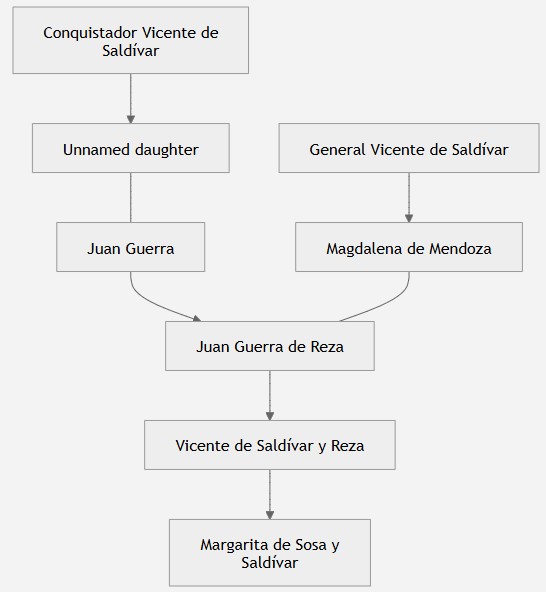
Combined Guerra–Saldívar line
Analysis of Both Sources
First generation: Juan Guerra and the Saldívar family
The first translation states that:
- Juan Guerra married an unnamed daughter of the conquistador Vicente de Saldívar.
- Vicente de Saldívar was therefore Juan Guerra’s father-in-law.
- The author identifies a later Juan Guerra de Reza as a descendant, apparently a son, of Juan Guerra.
- This would make Juan Guerra de Reza a maternal grandson of the conquistador Vicente de Saldívar.
The precise identity of Juan Guerra’s wife is not provided. She is only described as a daughter of Vicente de Saldívar.
Second generation: Juan Guerra de Reza
Both translations name Juan Guerra de Reza, making him the principal link between the records.
The first translation says:
- Juan Guerra de Reza and Ana de Zaldívar Mendoza were the parents of a young Vicente de Zaldívar.
- This Vicente was approximately 20 years old when prosecuted by the Inquisition in 1616.
- The author calls him:
- A grandson of Juan Guerra
- A great-grandson of the conquistador Vicente de Saldívar
The second translation says:
- Juan Guerra de Reza and Magdalena de Mendoza were the parents of Captain Vicente de Saldívar y Reza.
- Magdalena de Mendoza was herself the daughter of:
- General Vicente de Saldívar
- Doña Magdalena de Mendoza
This gives Juan Guerra de Reza another direct marital connection to the Saldívar family.
Third and fourth generations
According to the second translation:
- Captain Vicente de Saldívar y Reza, son of Juan Guerra de Reza, married María de Sosa.
- Their daughter was Margarita de Sosa y Saldívar.
The apparent descent is:
- Juan Guerra
- Juan Guerra de Reza
- Vicente de Saldívar y Reza
- Margarita de Sosa y Saldívar
Repeated Saldívar ancestry
Vicente de Saldívar y Reza appears to have received Saldívar ancestry through more than one line:
- His paternal grandmother was reportedly an unnamed daughter of conquistador Vicente de Saldívar.
- His mother, Magdalena de Mendoza, was reportedly a daughter of General Vicente de Saldívar.
- His surname, Saldívar y Reza, preserved both the Saldívar and Guerra de Reza family identities.
If the conquistador Vicente de Saldívar and General Vicente de Saldívar were the same man, then Juan Guerra de Reza may have married a close maternal relative. However, the translations do not provide enough information to prove that the two men named Vicente de Saldívar were identical.
Conflict between the records
The most important inconsistency concerns the mother of Juan Guerra de Reza’s son Vicente:
| First translation | Second translation |
|---|---|
| Mother: Ana de Zaldívar Mendoza | Mother: Magdalena de Mendoza |
| Son: Vicente de Zaldívar, about 20 in 1616 | Son: Captain Vicente de Saldívar y Reza |
| Juan Guerra’s grandson | Father of Margarita de Sosa y Saldívar |
The two Vicente references could represent:
- The same person, with one source giving his mother’s name incorrectly
- Two different sons of Juan Guerra de Reza, both named Vicente
- Sons from two different marriages
- A mistake made by the author of the first historical account
Chronologically, they could be the same man: a person aged 20 in 1616 would have been approximately 57 in 1653, making it reasonable for him to be Captain Vicente de Saldívar y Reza and the father of Margarita. Nevertheless, the conflicting maternal names prevent a definitive identification.
The strongest conclusion is that Juan Guerra and Juan Guerra Reza in the first record is the same person. I have not seen the inquisition record but it is very likely that the Ana de Zaldivar Mendoza and Magdalena de Mendoza are the same person. It is possible that the name of her mother was placed by error instead of her actual name in the marriage investigation. Keep inmind that these are just two records. I still need to do an exaustive search for all the records that mention them.
Let me know in the comments what yoru thoughts are on this and or if you have other records for them.
Sources:
- Jesus Amaya, Ameca, Protofundacion Mexicana El Origen de Su Propiedad Rural (Mexico, D. F., Editorial Lumen, 1951), Pg. 133.
- Maria de la Luz Montejano Hilton, Sagrada Mitra de Guadalajara Antiguo Obispado de la Nueva Galicia Expedientes de la Serie de Matrimonios Extractos Siglos XVII-XVIII (Mexico D.F, , 1999), Pg. 574 #2885.