
Bartolomé de Treviño: Original Settler, Surveyor, Rancher, and Patriarch of Camargo
Bartolomé de Treviño was born in Monterrey, Nuevo Reino de León, and became one of the original settlers of the Villa de Nuestra Señora Santa Ana de Camargo in Nuevo Santander, now Camargo, Tamaulipas. In his 1788 will, he described himself as a primer poblador—one of Camargo’s first settlers. Spanish land records similarly classified him as a primitivo poblador, or original settler.
Although his exact birth date and the names of his parents are not provided in the available records, Bartolomé was already considered elderly by September 1788. He stated that he remained in good health and possessed full judgment, memory, and understanding, but that he suffered from old age and its accompanying ailments.
Community representative and surveyor
Bartolomé played an important role in the formal organization of Camargo and the distribution of its lands. In August 1767, Spanish royal commissioners arrived in Camargo after completing their work in Mier. Their purpose was to establish the boundaries of the settlement and distribute land among qualified residents.
On August 2, 1767, José Antonio de la Garza Falcón reported that the settlers had granted power of attorney to himself, Bartolomé de Treviño, and Pedro José Ygnacio Saldaña. The three men were authorized to represent the settlers in matters concerning the distribution of land and the alcabala, a colonial sales tax.
The following day, the representatives nominated Matías Longoria and Santiago Longoria to serve as expert appraisers. Bartolomé and Saldaña also agreed to work as surveyors alongside Juan José de la Garza and Luis López, who represented the Spanish Crown.
Bartolomé was paired with Luis López. Together they surveyed eastward from the center of Camargo for six leagues until they reached Potrero de las Cucharas. They then returned to Camargo and surveyed westward toward the mission lands and the boundary with Mier.
After helping establish the general boundaries of the Camargo district, López and Treviño surveyed individual land grants. Beginning at Las Cucharas, near the boundary with Reynosa, they measured eighteen tracts along the Rio Grande, proceeding upriver from east to west toward the Camargo town tract. Their work helped establish the pattern of landownership that would shape the lower Rio Grande region for generations.
Porción 97
As one of Camargo’s original settlers, Bartolomé received Porción 97. The Spanish Crown formally granted the property on August 12, 1768. The tract contained approximately 6,198 acres and is now situated in Starr County, Texas. Texas land records identify it as Abstract S-272.
Bartolomé also participated in the formal possession of neighboring properties:
- He took possession of Porción 98 for his son José Lorenzo de Treviño.
- He took possession of Porción 99 for his son-in-law Ygnacio Anastasio de Ayala.
- He took possession of Porción 100 for Juan Gerónimo Vásquez.
These acts demonstrate that Bartolomé was a trusted and influential member of the community. He was not merely a recipient of land but also participated directly in surveying the district and implementing the official distribution of property.
First marriage
Bartolomé’s first wife was Ana María García de Buentello, originally from Monterrey. When they married, she brought two breeding cows, one yearling animal, and clothing given to her by her mother. Bartolomé entered the marriage with two trained horses and riding equipment. He acknowledged that neither possessed substantial wealth at the beginning of their marriage.
They had four legitimate children:
- María Gertrudis Treviño
- José Lorenzo de Treviño
- María Josefa Treviño
- Ana María Treviño
Following his first wife’s death, the children remained in the care of their maternal grandmother. Bartolomé stated that he continued providing them with food and support until they married.
His mother-in-law had also transferred to him a piece of farmland at Santa Catarina, within the jurisdiction of Monterrey. After his wife died, Bartolomé left the land to their daughters, who continued to possess it when he prepared his will.
José Lorenzo de Treviño, Bartolomé’s son from this marriage, received Porción 98 in Camargo. Bartolomé personally took possession of the property on his son’s behalf.
Second marriage
Bartolomé’s second wife was another woman named Ana María García. She was from San Gregorio de Cerralvo and was the widow of José Miguel de Chapa.
She had two sons from her previous marriage:
- Nicolás José de Chapa
- José Miguel de Chapa
Bartolomé accepted these young men into his household and referred to them as his stepsons. His second wife brought significant property into their marriage, including horses, cattle, sheep, goats, clothing, and household possessions. Bartolomé contributed eight young mares, five trained riding horses, and forty sheep.
Their marriage lasted approximately sixteen years. Bartolomé emphasized that the family’s estate grew through their combined capital and personal labor.
They had eight children:
- María Josefa Treviño
- María Teresa Treviño
- Bartolomé Treviño
- María Gertrudis Treviño
- Isabel María Treviño
- María Rosalía Treviño
- José Antonio Treviño
- José Eusebio Treviño
Bartolomé and his wife provided livestock and other property to their children and stepsons as they established their own households. José Lorenzo Treviño received twenty-five young mares with a breeding stallion, four trained horses, one hundred goats, twelve sheep, a used firearm, clothing, and cattle descended from a yearling animal assigned to him.
Bartolomé explained that José Lorenzo received property comparable to that given to Nicolás José and José Miguel de Chapa because José Lorenzo married a niece of Bartolomé’s second wife and had contributed his labor to the growth of the family estate.
After his second wife died, Bartolomé continued distributing livestock to their children. Most received twenty-five mares with a breeding stallion, approximately one hundred goats, and, in some cases, sheep, cattle, and trained horses.
At the time of the will, José Antonio was unmarried and older than twenty-five. María Rosalía had not received a comparable distribution and had lived for approximately eight years with her sister María Josefa. Bartolomé therefore ordered that María Rosalía receive twenty-five mares or young mares, a breeding stallion, and the value of one hundred goats.
The younger Bartolomé Treviño named in the will appears to be the man identified in later land-claim records as the son of the original grantee of Porción 97. Those records state that “Bartolomé Treviño” applied for Porción 97, which had originally been granted to his father, also named Bartolomé.
Third marriage
Bartolomé’s third wife was Francisca Salinas, a widow of Juan José García and a resident of the Camargo jurisdiction. She brought no property into their marriage.
They had one daughter:
- María Francisca Treviño
María Francisca married Alejandro de Olivares of Camargo. Bartolomé acknowledged that he had not previously given her property because she had been raised from birth in the home of one of her aunts and because her mother brought no capital into their marriage. To provide for María Francisca, he ordered that she receive twelve young mares from his estate.
Fourth marriage
At the time he prepared his will, Bartolomé was married to Antonia de Hinojosa, widow of Francisco Ignacio de Landa.
Antonia brought numerous possessions into their marriage, including clothing, bedding, jewelry, religious objects, kitchen utensils, agricultural tools, riding equipment, and metal implements. Among these were gold earrings, a gold ring, a silver spoon, copper cookware, a rosary, religious pictures, axes, a hammer, tongs, and other household items.
Bartolomé and Antonia had two sons:
- José Francisco Treviño, approximately seventeen or eighteen years old
- José Ignacio Treviño, approximately thirteen or fourteen years old
Bartolomé directed that the disposable fifth of his estate, after paying funeral expenses, religious obligations, and other legacies, be given to Antonia and their two sons.
Ranching and economic life
Bartolomé’s will demonstrates that he became a prosperous rancher and stock raiser. When he married Antonia de Hinojosa, he brought approximately:
- Twenty-two equipped pack mules
- About forty trained riding horses
- Five herds of mares
- Three trained donkeys
- Approximately one hundred cattle
- About two thousand sheep and goats
- Land, clothing, household goods, and riding equipment
By 1788, his remaining property included four herds containing approximately eighty breeding mares, four stallions, eighteen trained riding horses, a trained mule, fourteen young mules, approximately fifty additional horses and mules, nine breeding cows, and another fifteen to twenty cattle of various ages.
He also owned 220 sheep and fifty goats being kept on shares by his son-in-law Manuel Guerra, a resident of Mier. Another one hundred or more goats were kept with the livestock belonging to his son Bartolomé.
Livestock represented more than accumulated wealth. Bartolomé used horses, cattle, sheep, and goats to help his children establish their own households. These distributions reveal the importance of family labor and livestock ownership in the economy of eighteenth-century Camargo.
His home, ranch, and river crossing
Bartolomé owned a residence in Camargo constructed of adobe with a palmetto roof. It consisted of one principal room, an interior chamber, and a kitchen situated in front. The kitchen was enclosed with cane and roofed with palmetto. The house stood on a town lot that he had purchased.
He also owned a ranch on the land assigned to him during the visita general. In his will, Bartolomé explained that the porción of land he possessed was the same property officially awarded to him during the general distribution of land. He also owned a canoe at the ranch that was used to cross the river, showing that the property provided access to an important river crossing.
Debts and obligations
Bartolomé carefully recorded the debts that were to be paid from his estate. These included:
- Two hundred pesos owed to the estate of Ignacio de Ayala
- More than 130 pesos owed to José Antonio García of Pesquería Grande
- An unspecified amount owed to Ascencio de las Fuentes of Revilla
- More than forty pesos owed to the estate of José Nepomuceno Gil
Against the final debt, Bartolomé ordered that a credit of thirty-three pesos and six reales be applied for work performed by his son José Francisco with a mule train in 1787. He also instructed his executors to pay any other properly proven debts, regardless of whether the amount was large or small.
Will and heirs
Bartolomé prepared his will in Camargo on September 27, 1788. He appointed three executors:
- His son José Lorenzo Treviño
- His son-in-law Pedro López Prieto
- His wife Antonia de Hinojosa
He authorized them to take possession of his property and sell whatever was necessary to pay his debts, funeral expenses, religious obligations, and individual legacies.
After these obligations were satisfied, Bartolomé named his children as the universal heirs of the remainder of his estate. In total, his will identifies fifteen biological children from four marriages, as well as two stepsons whom he helped establish economically.
Bartolomé requested that his body be shrouded and buried in consecrated ground according to the decisions of his executors. He did not designate a particular church or chapel for his burial.
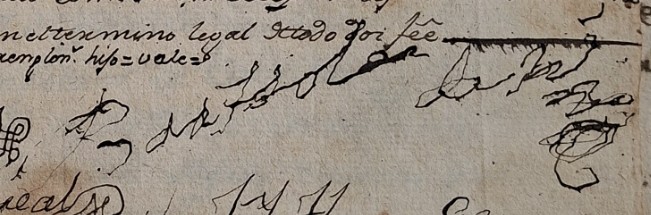
The will was witnessed by Ignacio Villarreal, Tomás Gutiérrez, Blas María de la Garza, Antonio Abad Solís, and José María Acevedo. Unlike many people appearing in the Camargo protocols, Bartolomé signed his own testament, indicating that he possessed at least some ability to write.
Later history of Porción 97
During the nineteenth century, another Bartolomé Treviño—apparently the original settler’s son—applied for Porción 97 as property originally granted to his father. Jacinto Gutiérrez and Fabián Gonzales supported the claim as witnesses, and the Bourland and Miller Commission recommended its confirmation.
Another claim was made by Guadalupe Treviño on behalf of himself and other heirs for Porciones 96 through 100, which were said to have been acquired by their father through grants and purchases.
The Texas Legislature confirmed Porción 97 to the heirs of Ygnacio Treviño on February 10, 1852. A patent was issued on March 27, 1880, in the names of Bartolomé and Ygnacio Treviño.
Legacy
Bartolomé de Treviño’s life reflects the expansion of Spanish settlement from Monterrey and Cerralvo into the lower Rio Grande region. Beginning his first marriage with only two horses and riding equipment, he eventually accumulated a substantial ranching estate consisting of land, cattle, horses, mules, sheep, goats, a town residence, and a river-crossing canoe.
His importance extended beyond his personal property. He represented the people of Camargo before the royal commissioners, surveyed the boundaries of the district, helped measure individual land grants, and participated in the formal possession of properties for relatives and other settlers.
Through four marriages, fifteen identified children, two stepsons, and numerous marital connections, Bartolomé established a family network extending from Monterrey and Cerralvo to Camargo, Mier, Revilla, Pesquería Grande, and the lands north of the Rio Grande.
Bartolomé de Treviño should therefore be remembered as one of Camargo’s original settlers, an official community representative, a surveyor of the town’s lands, a Spanish land grantee, a successful rancher, and the patriarch of an extensive Treviño family whose descendants remained connected to the lower Rio Grande for generations.
Sources
- New Guide to Spanish and Mexican Land Grants in South Texas:
- Book pages 55–56: Bartolomé’s appointment as a representative of the settlers and his surveying work in Camargo
- Book pages 65–66: Porciones 97–100 and Bartolomé’s actions on behalf of his son, son-in-law, and another settler
- Land-grant entry 4: Ygnacio Anastasio de Ayala, original grantee of Porción 99
- Land-grant entry 300, pages 296–297: Bartolomé Treviño and Porción 97
- Land-grant entry 306, page 298: José Lorenzo de Treviño and Porción 98
- Víctor M. Sáenz Ramírez, Los Protocolos de la Villa de Nuestra Señora Santa Anna de Camargo, 1762–1809:
- “Testamento de don Bartolomé Treviño,” pages 141–149
- Will executed at Camargo on September 27, 1788