
Book Review: Cadereyta Jiménez: Familias y sociedad (Padrón civil de 1839) — A Must-Have Resource for Genealogy Research
If your family has roots in Cadereyta Jiménez, Nuevo León, this book deserves a spot on your research desk. It’s not just a local history title—it’s a practical genealogy tool because it’s built around a transcribed 1839 civil census (padrón civil) that captures families, households, and community structure in a way that can break down stubborn brick walls.
What this book covers
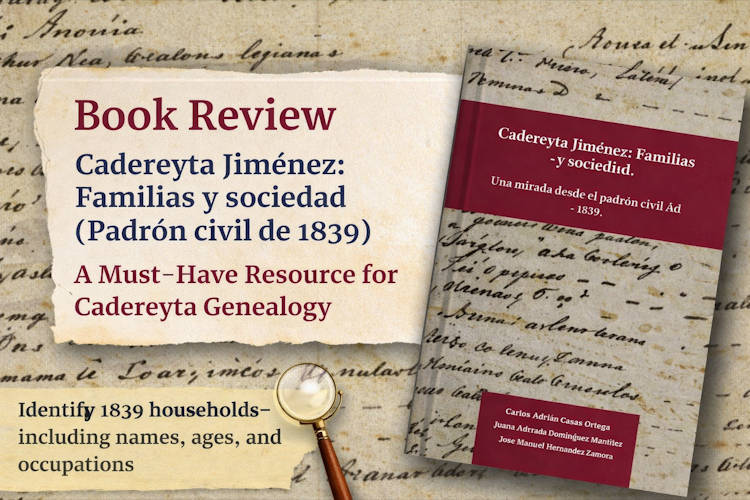
Cadereyta Jiménez: Familias y sociedad. Una mirada desde el padrón civil del año de 1839 is centered on a transcription (paleography) of the 1839 padrón civil for Cadereyta Jiménez. The authors, Carlos Adrián Casas Ortega, Juana Margarita Domínguez Martínez, and José Manuel Hernández Zamora, don’t simply provide a list of names—they frame the census with historical and social analysis to help readers understand how the community was organized and what the census can reveal beyond basic identity.
- Core value: a readable transcription of an 1839 census record
- Bonus value: context on society, family structure, and how to interpret what you’re seeing
Why genealogists should care about an 1839 padrón
Censuses and civil registers can function like a “snapshot” of a town at a specific moment. For genealogists, that snapshot can do several important things at once:
- Confirm an ancestor’s presence in Cadereyta in a specific year
- Show household groupings that suggest relationships
- Provide ages that help estimate birth years
- Include occupations that help distinguish people with the same name
- Reveal neighbors and clusters that often indicate kinship or compadrazgo networks
In other words: a padrón can help you go from “I think this is my person” to “This is my person—and here is their household, their likely relatives, and their social circle.”
Top strengths (from a genealogy perspective)
1) It makes a difficult source usable
One of the biggest obstacles in 1800s research is handwriting and inconsistent spelling. A well-prepared transcription saves you hours (or weeks) of squinting at scripts, guessing abbreviations, and misreading names. This book turns a challenging archival record into something researchers can actually work with.
2) It preserves household structure (genealogy gold)
Households matter. When people appear together under the same entry, you can often reconstruct family groups even when the document doesn’t explicitly label everyone’s relationship. This is especially helpful for identifying:
- Widowed parents living with adult children
- Orphaned minors living with extended family
- Multi-generational households
- Second marriages and blended families
3) It adds social context (the “why” behind the names)
Genealogy isn’t only about names and dates—it’s about people and community. This book helps you interpret the census as a reflection of how Cadereyta functioned socially: work, status, and how families were positioned within the town’s structure.
How this book can help you with Cadereyta genealogy
A) Prove residency in Cadereyta (1839 anchor)
If you find your ancestor (or surname cluster) in this padrón, you’ve established a firm time-and-place anchor. That can guide where you search next—especially if you’re trying to connect church records, civil records, or land/estate documentation across decades.
B) Rebuild family groups when records are thin
When baptism/marriage entries are missing, damaged, or hard to access, census households can fill the gaps. You may identify children in the home who don’t appear where you expected in parish registers—or discover an elderly parent living with a married child, which can help you correctly identify the previous generation.
C) Separate people with the same name
Nuevo León research often involves repeated names across generations. If your tree includes multiple “Juan Garcías” or “María de Jesús” individuals in the same timeframe, census details like age, household placement, and occupation can help you sort them out correctly.
D) Track migration and branch movement
Cadereyta connects genealogically to many places in Nuevo León and beyond. Once you identify a family group in 1839, you can more confidently trace that group forward into later records—or backwards into earlier parish documentation—while watching for movement into nearby communities and later migration routes.
A genealogist’s “how to use it” workflow
- Start with surnames: scan for your family names and list every occurrence.
- Group by household: capture each household entry as a mini family unit.
- Estimate birth years: use ages to estimate approximate birth ranges.
- Create a timeline: place each person into a simple timeline (birth estimate → marriage → children → later records).
- Cross-check with church records: baptisms, marriages, and burials to confirm relationships.
- Use neighbors as clues: recurring neighbor surnames often point to kinship networks.
Who will benefit most from this book?
- Descendants of Cadereyta families building documented lines
- Researchers working on surname studies for Nuevo León
- Genealogists trying to solve brick walls in the early-to-mid 1800s
- Anyone doing a one-place study of Cadereyta and surrounding communities
Final verdict
Overall rating (for genealogists): 5/5
This is the kind of genealogy resource that actually moves your research forward: it provides a primary source transcription that helps you identify households, estimate dates, separate same-name individuals, and reconstruct family clusters in Cadereyta Jiménez around 1839. If your ancestors were there—or if you suspect they were—this book can become a cornerstone reference for your family history work.
Get Your Free Copy Here